
Not long ago, growth had a simple formula: advertise, and you get there. All it needed was budget allocation & ads, which were then ably run, clicks were tracked, campaign optimised, and scaled. Visibility could be bought. Reach could be engineered. Results, at least in the short term, felt predictable.
Organic marketing was the slow top that no one wanted to invest in. But somewhere along the way, things changed.
Costs went up. Attention spans dropped. Audiences became more selective, almost instinctively filtering out anything that felt too transactional, too frequent, or too forced.
And suddenly, brands began asking a different question.
Not “How do we reach more people?” But “How do we stay relevant once we do?”
That shift is where organic marketing has quietly returned to the centre of the conversation.
From Visibility to Presence
In 2026, the difference between visibility and presence is becoming more apparent.
While visibility can be bought, presence has to be built. A paid campaign can bring people to your website. But what happens after that? Do they stay? Do they explore? Do they remember? Maybe. Maybe not
Organic marketing, on the other hand, works to make people remember. It’s not an alternate to paid marketing. It’s something that ensures that when someone discovers your brand, through search, content, or conversation, there is something meaningful for them to connect with.
What Organic Marketing Really Looks Like Today
Organic marketing is an ecosystem of tools that need to work in unison, despite being distinct.
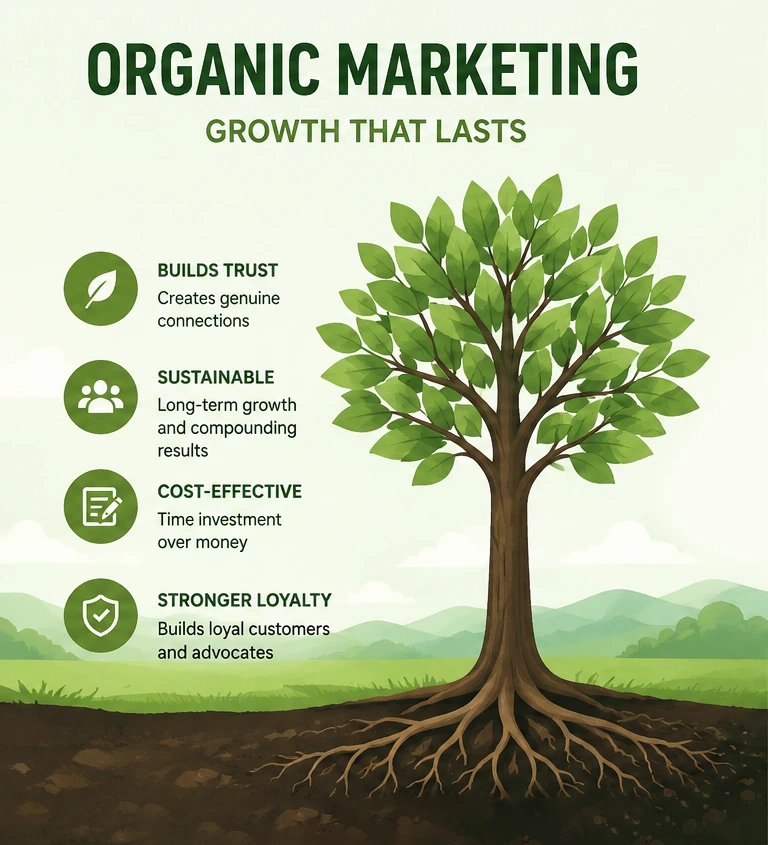
Let’s say a well-structured website that answers real questions, a blog that offers perspective, not just keywords, social media feeds that feel consistent, not reactive and articles and mentions that build credibility over time.
Individually, these may seem like individual steps, but when they all come together, they shape how a brand is perceived.
And perception, over time, translates to trust.
Why Brands Are Returning to Organic Growth
For many brands, the shift back to organic didn’t come from strategy. It came from experience.
Campaigns that once performed started plateauing. Costs increased. Returns became harder to sustain. And more importantly, the moment budgets paused, visibility disappeared.
The limitation of paid growth is that it is immediate, but not essentially enduring.
Organic growth behaves differently.
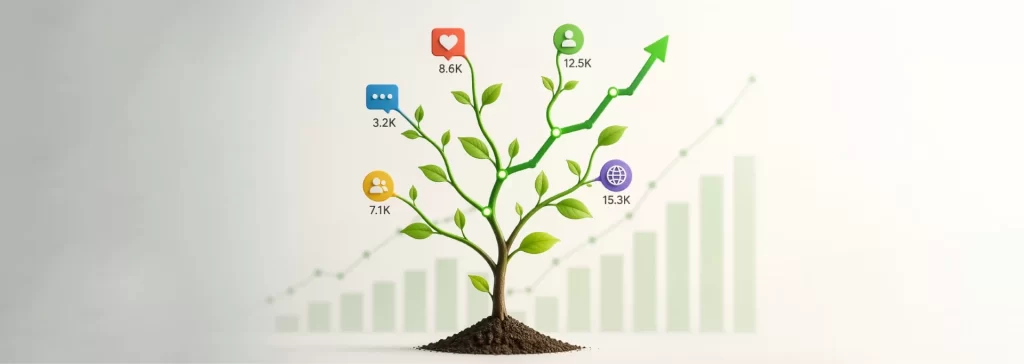
A single well-written article can continue to bring traffic months after it’s published. A strong SEO page can rank steadily over time. A thoughtful post can be saved, shared, and revisited. It’s slower, but it builds, and more importantly, it compounds.
The Algorithm Shift No One Can Ignore
Part of this change isn’t just about audience behaviour, it’s also about how platforms themselves are evolving.
Search engines and social platforms are no longer rewarding activity for the sake of activity. The rules have changed.
Algorithms today favour relevance over repetition, depth over volume, experience over optimisation tricks and credibility over cleverness.
This is why strategies that once worked, such as high-frequency posting, keyword-heavy content, or purely promotional messaging, are no longer effective.
The shift is subtle, but significant.
Instead of asking, “How much content are you creating?”, the real question has become, “How useful is it?”
And that is the big change.
Meaning Content – the way forward
There was a time when content calendars were built around frequency. Post daily. Stay visible. Keep the algorithm engaged.
But today, content that performs is not the most frequent; it is the most meaningful. Content that answers something, clarifies something or adds a perspective.
Brands are beginning to realise that one strong article can outperform ten average ones, a clear point of view attracts more engagement than safe messaging, and depth creates recall, not just impressions.
Content is no longer about presence alone. It’s about contribution.
SEO: The Quiet Performer
If there’s one part of organic marketing that keeps delivering, it’s SEO.
It’s not fast, but it’s steady and reliable. When someone searches for an answer or idea, and your brand appears naturally, it feels different. It’s not an interruption; it feels like a discovery.
That’s what makes SEO powerful.
SEO in 2026 is about more than just keywords. Keywords are still important, but now it’s also about understanding what people want, organising information clearly, making sure your site works well, and staying consistent over time.
When done well, SEO is one of the few marketing efforts that keeps working in the background, bringing in visitors without needing constant attention.
Social Media: From Noise to Narrative
Social media has perhaps seen the most visible shift. There was a time when success meant posting more.
Now, it means saying something worth noticing. Brands that perform well organically today are not the ones posting the most, but the ones communicating the most clearly. They have a defined voice, consistent visual identity and a point of view. Their content feels connected and meaningful. And that connection is what drives engagement.
The Role of PR in Organic Growth
SEO helps people find you, and content builds engagement. PR, on the other hand, builds credibility.
Being seen in the right places, quoted in the right context, or part of meaningful conversations adds trust that ads alone can’t create. It shows your brand isn’t just talking, it’s being recognised.
In a world where people question everything, that kind of recognition really matters.
The Trade-Off: Speed vs Stability
Organic marketing is not fast. That is perhaps its biggest limitation and its greatest strength.
It requires consistency, patience and a long-term view, but what it creates is far more stable. Over time, it reduces dependence on paid media as brand recall strengthens, building a presence that does not disappear overnight.
Final Thought
Organic marketing in 2026 isn’t just a trend but a return to the basics. It’s about moving away from chasing attention and focusing on earning it.
The brands that will grow aren’t the ones doing the most, but the ones doing what matters, again and again.
Because in the end, growth isn’t just about being seen. It’s about being remembered.